

I have spent a lot of hours testing modern video slots, and few mechanics have changed the way I think about a single spin as much as cascading reels. The first time I encountered the feature in a game like Cash of Cleopatra, I realised the old stop-and-evaluate rhythm was gone. Instead of watching symbols land and then anticipating for the next spin, I was monitoring a chain reaction. Winning combinations disappear, new symbols drop into the empty spaces, and fresh wins can occur without any extra wager. That cascading, tumbling, or avalanche-style mechanic transforms one paid spin into a sequence of chances, and Cash of Cleopatra develops its whole gameplay identity around that idea. Let me guide you through exactly how cascading reels work inside this Egyptian-themed title, what that signifies for your session, and why the mechanic is important see more details than a quick glance at the paytable might suggest.
The way Cascading Reels Function in Cash of Cleopatra
The fundamental idea underlying cascading reels is straightforward, but the way Cash of Cleopatra executes it uncovers design layers that shape every moment of play. When I click the spin button, the game examines all the symbols that have appeared on the grid. Any winning combination, if it is a cluster of matching icons or a line hit based on the engine, gets paid out right away following the paytable. Then, rather than leaving those winning symbols in place, the game takes them from the screen. The symbols over the empty spots drop down under a simulated gravity effect, and totally new symbols fall in from the top of the grid to occupy the gaps. The process reoccurs automatically: the game looks for for new wins, awards them, removes the winning symbols, and lets fresh icons cascade down until no more winning combinations appear. In Cash of Cleopatra, a single spin can extend across multiple tumbles. I have observed sequences where a modest first cluster starts three, four, or even more payouts in a row with no me moving a finger.
What makes the mechanic particularly engaging in this specific game is how it interacts with the win multiplier system. Each consecutive cascade during the same base-game spin increases a progressive multiplier that is displayed clearly on the screen. The first win payouts at the standard rate, but if removing those symbols creates a second winning combination, that payout gets a boost from a factor that rises with every tumble. I have seen the multiplier climb from one to two, then three, and occasionally much higher during a lucky streak of cascades. Because the multiplier resets to its starting value at the beginning of every paid spin, the cascading mechanic adds a layer of anticipation that a single static evaluation just cannot deliver. The interplay between symbol removal, new symbol delivery, and an escalating multiplier means that even a spin that starts with a low-value cluster can escalate into a solid return if the cascades continue.
The Cascade Mechanic and Payout Multipliers
In Cash of Cleopatra, the tumble feature is not simply a cosmetic animation; it is the engine that powers the game’s volatility profile. Each time a winning cluster is cleared, the remaining symbols reposition, and fresh symbols fall in from above. The game then re-evaluates the entire grid. If another cluster of at least the minimum required size has formed, the win is determined, the multiplier increments, and the process goes on. I think of the multiplier as a reward for persistence: the longer the chain of cascades, the higher the multiplier applied to each subsequent win. During the base game, the multiplier resets between paid spins, which preserves the mechanic exciting without making every session feel overly punishing. The visual and audio feedback enhances this rhythm. Each tumble comes with a distinct sound and a brief pause that enables me to register the new grid state before the next evaluation. That design choice converts what could be a passive waiting game into an active viewing experience where I am constantly scanning for the next potential cluster.
Design and Appearance
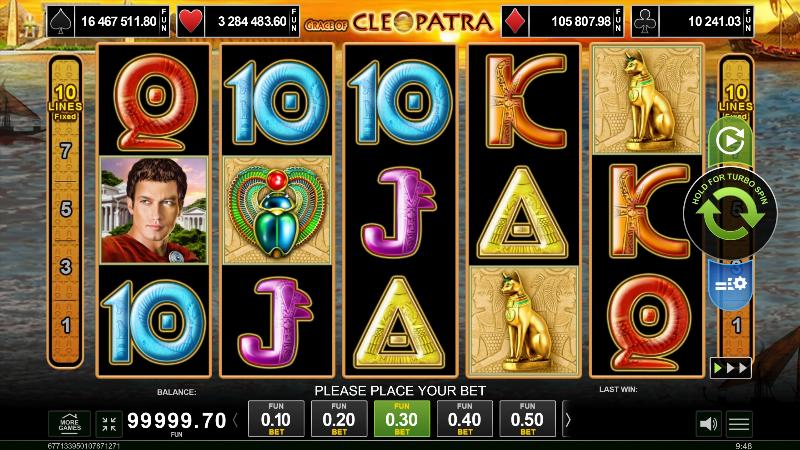
Cash of Cleopatra presents its cascading reel engine in an ancient Egyptian aesthetic that feels both known and polished. The background positions me inside a torch-lit temple chamber, with hieroglyph-covered pillars bordering the grid and a golden glow that indicates hidden treasure. The reels rest against a rich, dark stone surface, and the symbols are depicted with a metallic sheen that makes every cascade appear like a shower of coins and jewels. I notice the classic Egyptian iconography right away: the eye of Horus, scarab beetles, ankh crosses, and ornate fans, all crafted enough to keep the theme consistent. Cleopatra herself emerges as a high-value symbol, often depicted in regal profile with a headdress that reflects the light. The lower-paying symbols tend to be stylised card royals, but even these are decorated with Egyptian motifs so they do not shatter the visual spell.
The sound design supports the theme without becoming distracting. A low, rhythmic drumbeat underscores the base game, and when a cascade initiates, the tempo picks up slightly, adding a subtle sense of urgency. Each tumble is accompanied by a crisp, metallic clink that echoes coins falling onto a pile, and when the multiplier rises, a short ascending chime reinforces the feeling of forward motion. I appreciate that the audio cues are useful as well as mood-setting: I can often discern how many cascades have taken place just by listening to the pitch of the multiplier chime. The blend of sight and sound causes the cascading mechanic feel tangible, as if I am physically dislodging loose more treasure with every successive drop of symbols. This sensory response is a big part of why the game keeps attention over longer sessions, because it turns each spin into a small narrative of collapse and renewal.
Návratnost hráče, Volatility, and Možnost výher
Understanding the herní mechanismus behind Cash of Cleopatra is essential for nastavení realistických očekávání before I usednu to play. The theoretical return to player for this game standardně činí around 96.2 percent, which places it in line with many modern video slots that feature cascading reels. This údaj představuje the long-term average payout across millions of simulated spins, and it does not slíbit what will happen in any individual session. I always uvědomuji si that RTP is a statistical measure, not a slib, and that short-term results can výrazně se odchýlit. The game’s kolísavost, which I would charakterizovat as medium to high, means that wins are not pravidelné. I can projít stretches of spins where the cascades vyhasnou after a single small cluster, poté přijde a sudden burst where multiple tumbles and a climbing multiplier produce a payout many times my stake.
The možnost výher is closely tied with the cascading multiplier system. In the base game, the maximum win cap is often stanoven at a multiple of the total bet, často around 5,000 times the stake, though this can only be approached during an exceptionally long cascade sequence or within the free spins feature where the multiplier má odlišné chování. The high volatility naznačuje that honění the top prize vyžaduje patience and a bankroll that can překonat dry spells. I find it prospěšné to view the cascading mechanic as a volatility amplifier: because a single spin can effectively become several spins’ worth of evaluations, the outcomes are more výrazné than they would be in a static slot with the same math model. This is neither good nor bad in itself, but it does znamenat I need to adjust my bet sizing and session length podle toho. The game’s design ocení those who understand that the biggest moments come from the multiplier stacking across multiple cascades, not from any single symbol combination alone.
Betting Range and Top Payout
Cash of Cleopatra caters to a broad spectrum of playing styles through a flexible betting range that usually begins at around twenty pence per spin and goes up to one hundred pounds or more, depending on the casino operator hosting the game. I value that the lower end of the range allows me to examine the cascading mechanics and get a feel for the volatility without investing a large portion of my bankroll. At the same time, the higher bet options provide players who prefer more substantial stakes the ability to chase the game’s maximum advertised win, which is often capped at 5,000 to 10,000 times the total bet. This cap is not an unfounded number; it is a mathematical limit integrated into the game’s design to ensure that the top prize can actually be distributed under normal operating conditions. Because the cascading multiplier can expand so rapidly during free spins, reaching the max win is in theory possible from a single well-timed bonus round, though I treat such an outcome as an uncommon event rather than a likely one.
The link between bet size and the cascading mechanic is worth studying closely. When I raise my stake, the absolute value of each cascade win rises proportionally, but the underlying probability of activating a long chain of tumbles remains unchanged. This means that a higher bet enhances both the potential rewards and the potential losses during a session. I deem it prudent to select a bet level that allows me to weather the natural variance of a medium-to-high volatility game without experiencing pressure to chase losses. The game’s interface commonly features clear plus and minus buttons for modifying the total bet, and the current stake is shown prominently so I never forget of what each spin is costing me. Responsible bankroll management is especially important in a cascading reel slot because the rapid succession of tumbles can create an appearance of frequent wins even when the net result of a spin is a loss relative to the stake.
Extra Features and Unique Symbols
Cash of Cleopatra does not depend entirely on the base-game cascades to deliver its most unforgettable moments. The game contains a scatter symbol, typically represented by a golden pyramid or a temple entrance, that activates the free spins round when a required number appear anywhere on the grid. I have found that three or more scatters are generally required to trigger the feature, and the number of free spins granted often depends on the number of qualifying scatters. During the free spins, the cascading multiplier does not go back between paid spins; alternatively, it commences at a greater value and keeps growing with every tumble across the whole feature. This persistent multiplier converts the free spins round into a intense sequence where each cascade feels more important than the last, because the multiplier never drops back to its base level until the feature ends.
Wild symbols also play a vital supporting role in the cascading ecosystem. The wild, often depicted as a shining golden scarab or the game’s logo, substitutes for all regular paying symbols to help complete clusters. When a wild is part of a winning cluster, it is removed along with the other winning symbols during the cascade, which can unlock new possibilities for the next tumble. I have seen instances where a wild sitting in the middle of a dense cluster triggers a cascade that brings two separate groups of premium symbols together, creating a much larger win than either group could have achieved alone. Some versions of the game also include a special multiplier wild that carries its own value, adding an extra layer of planning to the cascade chain. The relationship between wilds, scatters, and the tumble mechanic means that no two bonus rounds ever feel exactly the same.
Free Spins with Progressive Multipliers
This free spins bonus in Cash of Cleopatra is where the cascading reel system truly displays its ceiling. Once the round is initiated, I am awarded a set of initial spins, and the progressive multiplier that typically resets between base-game spins now continues active and only grows. The multiplier often commences at a humble level, perhaps two or three times, but each consecutive cascade during any free spin pushes it up. Because the multiplier never resets for the duration of the round, a single hot streak of tumbles late in the round can retroactively amplify all subsequent wins to remarkable levels. This design generates a real sense of buildup; I find myself edging closer to the screen as the multiplier climbs past five, then ten, and occasionally beyond. The free spins can sometimes be reactivated by landing additional scatter symbols during the feature, extending the round and giving the multiplier even more room to grow. It is this blend of sustained multiplier and cascading chain reactions that renders the bonus round the main point of the game’s maximum win capacity.
How to Enjoy Cash of Cleopatra
Beginning with Cash of Cleopatra is refreshingly simple, including for someone who has never encountered a cascading reel slot before. I start by setting my total bet using the on-screen controls, which usually sit beneath the reels. Once I am comfortable with the stake, I press the large spin button to set the grid in motion. The symbols fall into position from above, and the game immediately assesses the entire six-by-five grid for winning clusters. If a cluster of at least the required size is present, the winning symbols are highlighted, the payout is added to my balance, and the cascade sequence commences. I do not need to press anything else; the game handles the removal of winning symbols, the downward tumble of remaining icons, and the delivery of new symbols automatically. This cycle loops until no further winning clusters appear, at which point the spin is complete and I can begin the next one.
For players who favor a more hands-off approach, the game typically features an autoplay function that lets me set a predetermined number of spins to run automatically. I can often configure loss limits or single-win stop conditions within the autoplay settings, which helps me preserve control over my session. I also suggest trying the game in demo mode first if the option is available, because the cascading mechanic and cluster-pays system can feel quite different from traditional payline slots. Dedicating ten or fifteen minutes with virtual credits allows me to observe how clusters form, how the multiplier increments, and how the free spins trigger without any financial pressure. Once I transition to real-money play, I always keep an eye on the scatter symbols, because landing three or more is the gateway to the feature where the cascading multiplier truly shines. The game’s paytable, accessible via an information button, provides a full breakdown of cluster sizes, symbol values, and feature rules, and I make a habit of reviewing it before each session to refresh my memory.
Grid Layout, Win Lines, and Ways to Win
Instead of traditional paylines that extend from left to right, Cash of Cleopatra utilizes a cluster-pays system on a grid that usually spans six reels wide and five rows tall. In this format, I am not looking for matching symbols on fixed lines; I am looking for groups of identical symbols that adjacent each other horizontally or vertically anywhere on the screen. The minimum cluster size necessary for a payout is commonly eight matching symbols for the lowest-paying icons, while the premium symbols such as Cleopatra herself can award a win with as few as five connected symbols. This shift from paylines to clusters completely transforms how I scan the grid after each cascade. Instead of tracing lines, my eyes scan for dense patches of colour, and the cascading mechanic becomes even more critical because the removal of one cluster can bring previously separated symbols together to form a new, larger reddit.com cluster.
The six-by-five layout delivers thirty symbol positions, which offers the cascading engine plenty of room to create chain reactions. When a winning cluster is removed, the symbols above descend, and new symbols fill the top row. Because the grid is relatively tall, a single cascade can shift the entire composition of the lower rows, potentially connecting symbols that were initially far apart. I have seen that the game’s symbol distribution seems tuned to encourage frequent small cluster formations, which maintains the cascades flowing regularly enough to maintain engagement. The absence of fixed paylines also means that the visual clutter of line indicators is gone, leaving the grid clean and easy to read. For a player used to traditional line-based slots, the cluster-pays approach may take a few spins to internalise, but once the pattern recognition clicks, the cascading mechanic feels like a natural partner to this way of forming wins.
Strategic Considerations for Tumbling Reel Games
While no tactic can affect the random number generator that decides each spin’s conclusion, I have discovered that a careful approach to session management can substantially enhance my experience with cascading reel slots like Cash of Cleopatra. The first guideline I use is to align my bet size to the game’s risk. Because the cascading system can generate long runs of non-winning or low-paying drops, I require a bankroll that can readily withstand at least eighty to one hundred spins without causing me to quit prematurely. I usually allocate my session budget by that number and adjust my bet accordingly, which offers me a decent opportunity of triggering the free spins feature at least once. The persistent multiplier during free spins is the engine of the game’s biggest payouts, so lasting long enough to trigger the bonus round is a sensible goal.
I also closely monitor the way the successive multiplier operates in the main game versus the free spins. In the main game, the multiplier clears after each wagered spin, which means that a extended cascade chain is worthwhile but does not transfer to the following spin. This leads me to see each spin as an independent event and to steer clear of the urge to raise my bet after a big cascade, because the next spin begins anew. During free spins, however, the multiplier’s retention alters the dynamic entirely. Once the feature commences, every tumble counts, and I catch myself in my mind following the multiplier’s increase as a indicator of the round’s promise. Recognizing this fundamental difference helps me stay disciplined: I overcome the desire to chase losses in the primary game, knowing that the true swing potential is concentrated in the bonus round. No amount of pattern recognition or timing can affect when the scatters will land, so I concentrate on what I can influence, that being my bet size, my session length, and my willingness to leave when the entertainment value has been met.
Cash of Cleopatra illustrates that cascading reel mechanisms are considerably more than a visual novelty; they redefine the whole pace and reward structure of a slot round. By transforming a one spin into a sequence of linked evaluations and layering a progressive multiplier on the top, the game generates periods of genuine tension and release that fixed reels hardly equal. The cluster grid, the ongoing free-spins multiplier, and the Egyptian theme all help to strengthen the core mechanic rather than take away from it. I leave from a game with a clear understanding that the cascading system rewards patience and penalizes rash bet hikes, and that the most memorable wins come not from any individual symbol but from the ripple effect that comes after. For anyone curious about how current slot design can convert a simple spin into an unfolding event, Cash of Cleopatra presents a refined and instructive example. My suggestion is to handle it with a predetermined budget, a clear head, and an understanding for the way each drop writes a compact, unexpected narrative on the board.
FAQ
What precisely are cascading reels within Cash of Cleopatra?
Cascading reels, also known as tumbling or avalanche reels, remove winning symbols off the grid following a payout and let new symbols to drop into the empty spaces. This process reoccurs automatically, potentially creating multiple wins out of a single paid spin. In Cash of Cleopatra, each successive cascade within the same spin increases a win multiplier, making longer chains of tumbles significantly more valuable than a single static win.
How exactly does the cluster-pays system operate in this game?
Instead of fixed paylines, Cash of Cleopatra uses a cluster-pays mechanic on a six-by-five grid. A win is created when a group of matching symbols touches horizontally or vertically. The minimum cluster size is generally eight symbols for low-paying icons and five for premium symbols. The cascading mechanic then removes the winning cluster, allowing new symbols to drop and possibly form additional clusters.
What is the RTP and volatility of Cash of Cleopatra?
The theoretical return to player is generally around 96.2 percent, which is typical for cascading reel slots. The volatility is medium to high, meaning wins could be infrequent but substantial when they occur. The cascading multiplier and free spins feature amplify this volatility, so sessions can include long dry spells followed by sudden large payouts. Always check the specific RTP displayed in the theguardian.com game’s information panel.
How do I trigger the free spins round?
Free spins are triggered by landing a particular number of scatter symbols on the screen, typically three or more. The precise number of free spins granted varies with how many scatters appear. During the bonus, the cascading win multiplier does not clear between spins, letting it to climb constantly throughout the full round. More scatters can reactivate extra free spins, prolonging the bonus.
How much is the maximum win available in Cash of Cleopatra?
The game promotes a maximum win cap that is often set at 5,000 to 10,000 times the total bet. Hitting this limit needs an extremely long cascade sequence during the free spins round, where the persistent multiplier can rise to very high levels. The max win is a theoretical ceiling, and while it is possible, most sessions will produce more modest results that reflect the game’s medium-to-high volatility.
Can I play Cash of Cleopatra for free before wagering real money?
Many online casinos provide a demo or practice mode for Cash of Cleopatra, letting you to spin the reels with virtual credits. This is an excellent way to learn the cascading mechanic, cluster-pays system, and bonus features without financial risk. I always advise trying out demo mode to observe how the multiplier grows and how frequently the free spins activate before committing real funds.